
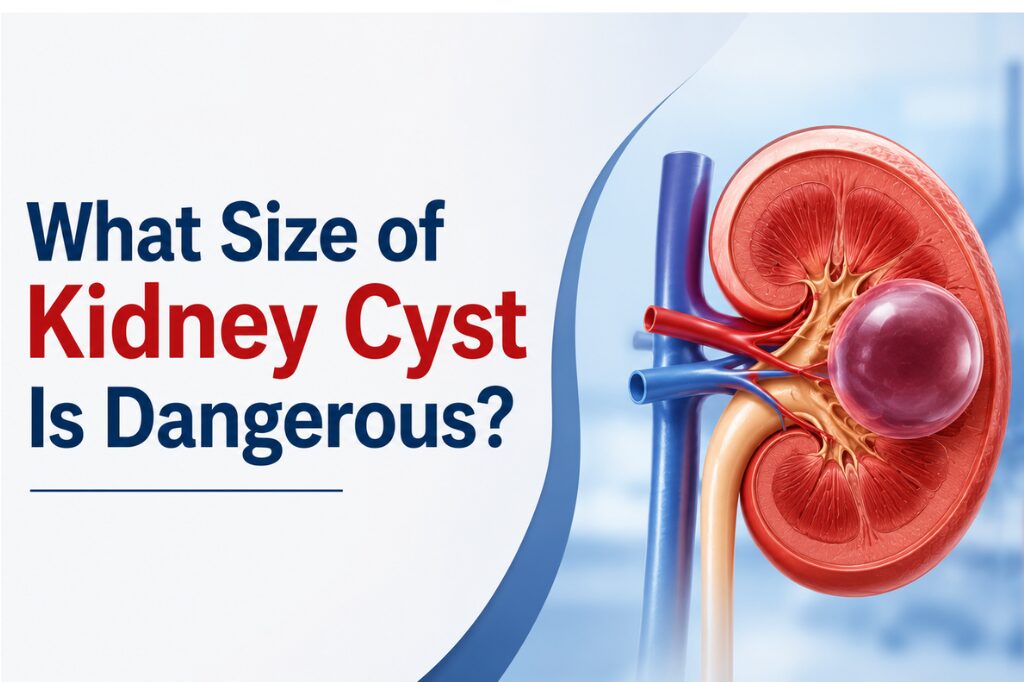
Kidney cysts are fluid-filled sacs that develop within or on the surface of the kidneys. In many cases, they are discovered accidentally during imaging tests performed for unrelated medical conditions. Most kidney cysts are harmless and do not cause symptoms. However, some cysts can grow larger, lead to complications, and require medical attention.
One of the most common questions patients ask is: What size of kidney cyst is dangerous? The answer depends on several factors, including the cyst’s size, location, growth rate, and internal characteristics. A small cyst can sometimes be more concerning than a larger one if it has suspicious features.
If you experience symptoms such as persistent flank pain, blood in the urine, recurrent urinary infections, or a rapidly enlarging kidney cyst, seeking evaluation from the Best Nephrology Hospital in Greater Noida can help ensure timely diagnosis, expert management, and appropriate treatment planning.
The size of a kidney cyst is one of the first things doctors evaluate after diagnosis. Small cysts are extremely common, especially among older adults, and often require no treatment.
Generally:
However, size alone does not determine danger. The internal structure and imaging appearance are equally important.
A simple cyst measuring 6 cm may be less concerning than a complex cyst measuring only 2 cm. Doctors evaluate:
Although many patients focus on cyst size, nephrologists and urologists consider several additional risk factors.
A cyst that grows rapidly over a short period deserves further evaluation. Stable cysts are generally less concerning than those showing continuous enlargement.
The position of the cyst can affect kidney function. A cortical cyst in kidney tissue is often benign, but large cortical cysts may occasionally affect nearby structures.
Simple cysts contain only fluid. Complex cysts may contain calcifications, thick walls, or solid areas that require closer monitoring.
Even a moderate-sized cyst may require treatment if it causes pain, urinary obstruction, or recurrent infections.
Many people wonder what is cyst in kidney and why these structures form.
A kidney cyst is a sac filled with fluid that develops within kidney tissue. The exact mechanism is not always clear, but age-related changes are believed to contribute significantly.
Research suggests that simple kidney cysts become increasingly common with age. Studies indicate that more than 50% of adults over the age of 50 may develop at least one kidney cyst.
Most remain harmless throughout life and never affect kidney function.
Several factors may contribute to cyst development.
Age-Related Changes
The likelihood of developing kidney cysts increases significantly with advancing age.
Genetic Conditions
Certain inherited disorders increase the risk of multiple kidney cysts.
Kidney Injury
Previous trauma or damage may occasionally contribute to cyst formation.
Structural Changes
Changes in kidney tubules can lead to fluid accumulation and cyst development.
Many cysts cause no symptoms and remain undetected for years. However, larger cysts can create noticeable health concerns.
Flank or Back Pain
Pain may occur when a cyst enlarges and places pressure on surrounding tissues.
Abdominal Fullness
Very large cysts can create a sensation of heaviness or fullness.
Blood in Urine
Occasionally, cysts may bleed and cause visible or microscopic blood in urine.
Urinary Problems
Compression of urinary structures can affect normal urine flow.
Infection
Infected cysts can produce fever, pain, and general illness.
Warning Signs That Need Medical Evaluation
A frequent concern among patients is: is cortical cyst in kidney dangerous? A cortical cyst develops in the outer portion of the kidney, known as the cortex. Most cortical cysts are simple cysts and are considered benign.
However, certain circumstances require closer attention:
Large Cortical Cysts
As they enlarge, cortical cysts may compress nearby tissues and cause discomfort.
Complex Cortical Cysts
Complex features observed on imaging studies may require additional diagnostic evaluation.
Multiple Cysts
Numerous cysts can sometimes indicate an underlying inherited kidney disorder.
Fortunately, most cortical cysts remain stable and never progress to serious disease.
Many patients immediately worry after learning they have a kidney cyst. The answer to is a cyst on kidney serious depends on the type of cyst present.
Simple Kidney Cysts
These are typically harmless and rarely require treatment.
Complex Kidney Cysts
Complex cysts may require advanced imaging, periodic surveillance, or additional evaluation.
Large Symptomatic Cysts
Even benign cysts may become problematic when they grow large enough to cause symptoms.
The majority of kidney cysts discovered during routine imaging are not cancerous.
Accurate diagnosis helps determine whether monitoring or treatment is necessary.
Ultrasound
Ultrasound is often the first test used to identify kidney cysts.
CT Scan
CT imaging provides detailed information about size, structure, and complexity.
MRI
MRI may be recommended when additional characterization is needed.
Blood and Urine Tests
These tests help evaluate kidney function and detect associated abnormalities.
Doctors often use the Bosniak classification system to assess complex kidney cysts and estimate risk.
Not all cysts require intervention. Treatment depends on symptoms, size, and imaging findings.
Observation and Monitoring
Most simple cysts are monitored periodically through imaging studies.
Aspiration
Fluid may be drained from symptomatic cysts using a needle-guided procedure.
Sclerotherapy
After drainage, medication can be injected to reduce recurrence.
Surgical Treatment
In selected cases, minimally invasive surgery may be recommended.
Kidney Cyst Removal
Kidney cyst removal may be considered when:
Modern minimally invasive techniques have significantly improved recovery times.
Although many cysts cannot be prevented, healthy lifestyle habits support overall kidney function.
Stay Hydrated
Adequate hydration supports healthy kidney function and urinary tract health.
Monitor Blood Pressure
High blood pressure can affect long-term kidney health.
Regular Follow-Up
Routine imaging helps detect significant changes before complications develop.
Follow Medical Advice
Patients should adhere to recommended monitoring schedules and treatment plans.
Kidney cysts are common and often harmless findings. When asking what size of kidney cyst is dangerous, it is important to understand that size is only one part of the evaluation. While larger cysts may increase the likelihood of symptoms or complications, factors such as growth rate, location, and internal structure are equally important.
Most simple kidney cysts require only observation, while complex or symptomatic cysts may need further investigation or treatment. Early diagnosis, regular monitoring, and consultation with a qualified kidney specialist can help ensure optimal kidney health and prevent unnecessary complications.
