
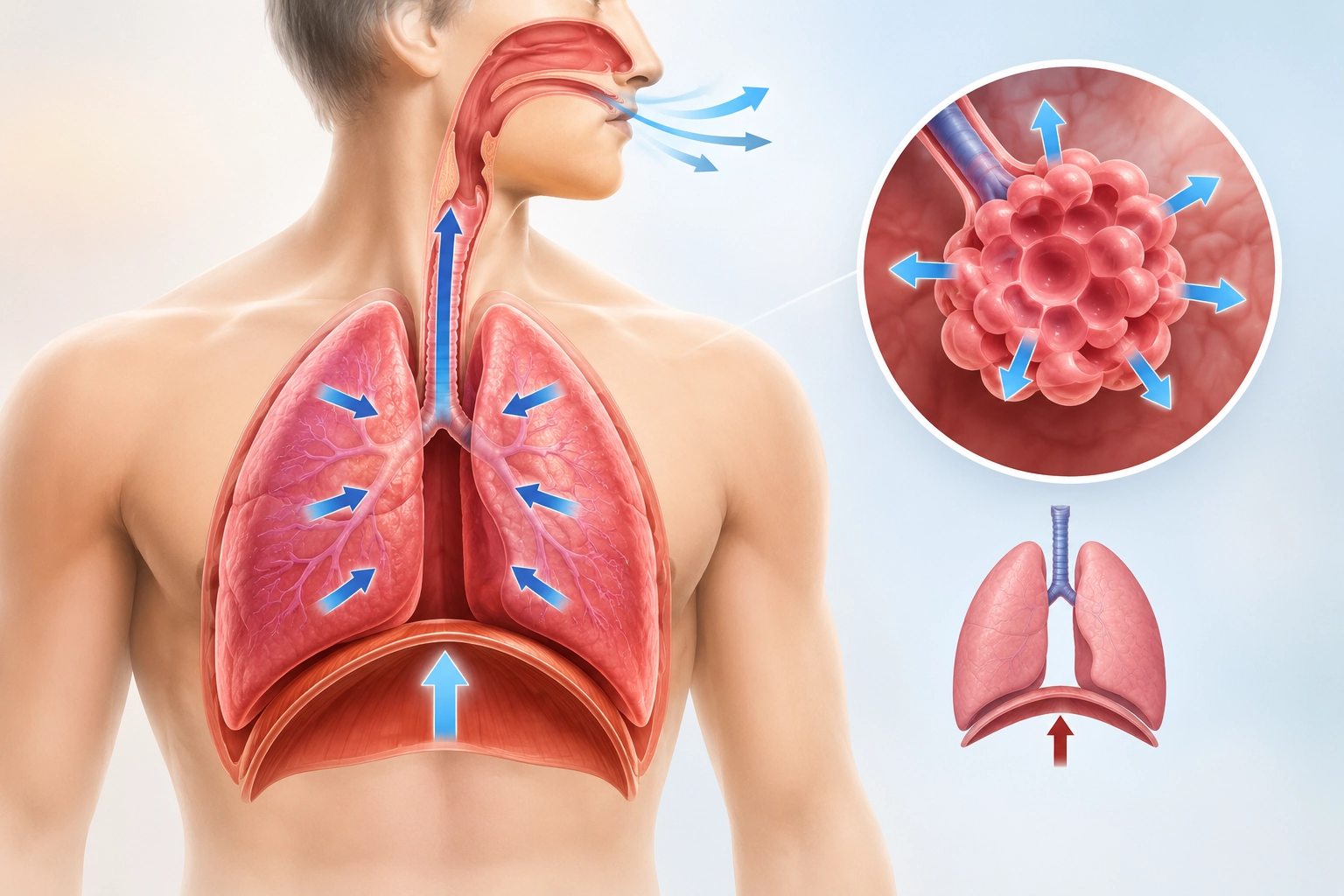
Have you ever wondered why air leaves your lungs without any effort? The answer lies in pressure. Expiration takes place when the intrapulmonary pressure is higher than the pressure of the air outside the body.
In this guide, you will learn how this simple rule works. We will cover the mechanism of breathing, the role of muscles, and the physics behind every exhale.
Intrapulmonary pressure is the air pressure inside the alveoli. It is also called intra-alveolar pressure.
Atmospheric pressure is the pressure of the air around you. At sea level, it is about 760 mmHg.
Air always moves from a high-pressure area to a low-pressure area. So expiration takes place when the intrapulmonary pressure is above 760 mmHg. The air then flows out through the airways.
During quiet breathing, the change is tiny. The pressure rises to about +1 mmHg relative to the atmosphere. That small gap is enough to push air out.
Define Pulmonary Ventilation First
To define pulmonary ventilation, think of it as the movement of air into and out of the lungs. It has two phases: inspiration and expiration.
Pulmonary ventilation depends on pressure gradients. Those gradients are created by changes in chest volume.
The mechanism of breathing is a cycle of volume and pressure changes. Boyle’s law explains it. When volume goes up, pressure goes down, and when volume goes down, pressure goes up.
Here is the cycle in order:
Relaxation of the diaphragm lets it dome upward. The ribs move down and in.
The lungs also recoil like a stretched balloon. Elastic fibers and surface tension pull them back to a smaller size.
As lung volume falls, the air inside is squeezed. Pressure rises. Expiration takes place when the intrapulmonary pressure is higher than the outside air, and the gradient drives air out of the nose and mouth.
Many students mix up these two terms. The mechanism of respiration is the broader process. It includes gas exchange in the lungs, gas transport in the blood, and cellular respiration in the tissues.
Breathing is only the first step. It moves air to the alveoli. Without it, the rest of the chain stops. Expiration takes place when the intrapulmonary pressure is higher after each inhale.
Knowing inspiration and expiration differences makes the pressure rule easier to remember. Expiration takes place when the intrapulmonary pressure is the higher value.
Feature | Inspiration | Expiration |
Intrapulmonary pressure | Below atmospheric (about −1 mmHg) | Above atmospheric (about +1 mmHg) |
Diaphragm | Contracts and flattens | Relaxes and domes |
Chest volume | Increases | Decreases |
Energy use at rest | Active | Passive |
Airflow | Into the lungs | Out of the lungs |
In short, expiration takes place when the intrapulmonary pressure is higher, while inspiration takes place when it is lower.
During rest, expiration is passive. No muscle effort is needed because elastic recoil does the work.
During exercise, coughing, or singing, expiration becomes active. The internal intercostals and abdominal muscles squeeze the chest.
In forced exhalation, intrapulmonary pressure can climb far higher than +1 mmHg. Expiration takes place when the intrapulmonary pressure is much greater, so air leaves faster.
Pressure Values at a Glance
Intrapleural pressure stays lower than intrapulmonary pressure. This difference keeps the lungs stretched against the chest wall.
There are several types of breathing, and each changes pressure in its own way:
In every one of these types of breathing, expiration takes place when the intrapulmonary pressure is higher than the air outside.
Many learners believe the lungs push air out on their own. In fact, the lungs have no muscle of their own.
Another myth says expiration always needs effort. This is false. Expiration takes place when the intrapulmonary pressure is raised by recoil, not by muscle force, during quiet breathing.
A third myth says pressure inside the lungs stays fixed. It does not. It rises and falls with every breath.
Blowing up a balloon is a good example. You squeeze your chest and abdomen, and lung pressure climbs well above the air outside. Air rushes into the balloon.
A cough works the same way. Pressure builds behind a closed airway. When the airway opens, air bursts out at high speed.
Sneezing, laughing, and singing follow the same rule. In each case, expiration takes place when the intrapulmonary pressure is higher than the surrounding air.
Quick Memory Tip: Expiration Takes Place When the Intrapulmonary Pressure Is Above 760
Remember this short line: lower pressure pulls air in, higher pressure pushes air out.
If you are studying for an exam, link it to volume. Small chest volume means high pressure. Large chest volume means low pressure.
Lung tissue is rich in elastic fibers. They stretch during inspiration and spring back afterward.
Surfactant also helps. It lowers surface tension, so the alveoli do not collapse. Even so, expiration takes place when the intrapulmonary pressure is raised by this gentle recoil, and no energy is spent.
Not all air you move reaches the gas exchange zone. Alveolar ventilation is the part of each breath that reaches the alveoli.
The formula is (tidal volume − dead space) × breathing rate. With 500 mL, 150 mL, and 12 breaths per minute, the result is 4,200 mL per minute.
The ventilation perfusion ratio compares this airflow with blood flow in the lungs. The ideal value is near 0.8.
Good pressure changes support good alveolar ventilation, since expiration takes place when the intrapulmonary pressure is high enough to clear stale air. If exhalation is blocked, air gets trapped and the ratio can fall out of balance.
Some diseases disturb the pressure rule. In asthma and COPD, narrowed airways resist outflow.
Even if expiration takes place when the intrapulmonary pressure is higher, the air cannot leave quickly. Air trapping follows, and breathing feels hard.
Common warning signs include:
Spirometry measures how fast and how much air you can blow out. Doctors use it to spot these problems early.
These habits keep the airways open, so expiration takes place when the intrapulmonary pressure is raised without resistance.
